
Hansford Parole and Probation Compared
Both forms of supervision can place a person in the community, but they arise from different decisions. The Texas Board of Pardons and Paroles decides parole and mandatory-supervision cases. The TDCJ Parole Division then handles release processing and field supervision. Probation, formally called community supervision, comes from the sentencing court and is administered by a Community Supervision and Corrections Department, or CSCD.
A person can complete a sentence with no active supervision. Another person may leave a TDCJ unit yet remain on parole for years. A probation order may follow a county case without any TDCJ confinement. These differences make the judgment, release record, and agency confirmation more useful together than any one lookup.
| Point | Parole or mandatory supervision | Probation |
|---|---|---|
| Who orders it | Texas Board process under a state sentence | Sentencing court |
| Who supervises | TDCJ Parole Division | Local or multi-county CSCD |
| Hansford route | Amarillo District Parole Office | Hansford, Ochiltree, and Hutchinson CSCD grouping |
| Key proof | Release certificate and active-office confirmation | Judgment or community-supervision order and CSCD confirmation |
- Parole
- Conditional community release before a state sentence fully expires.
- Mandatory supervision
- A separate Texas release route based on statute, credit, eligibility, and in many cases Board review.
- Probation
- Court-ordered community supervision, often without a state prison term.
- Discharge
- The formal end of a sentence or supervision term, not merely release from a facility.
Verify Hansford Post-Release Supervision
Start with the type of case. A Hansford County jail departure does not itself tell whether parole or probation applies. If the record shows transfer to TDCJ, use the state route. If a court judgment orders community supervision, use the CSCD route. The public TDCJ inmate search covers current incarceration, so a former inmate may no longer appear there.
- Obtain the judgment, release certificate, or county release and transfer record. Note the court, agency, case number, and TDCJ or SID number when available.
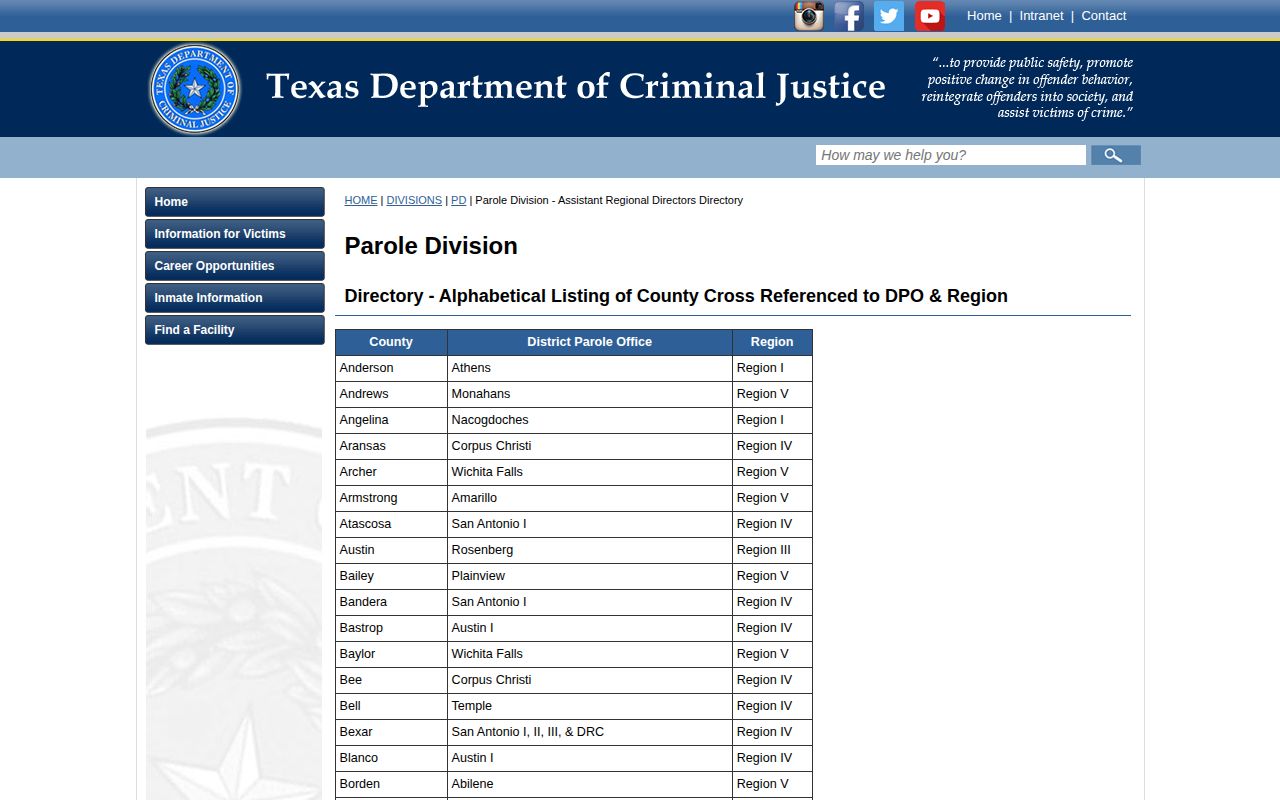
- For state parole, confirm the Hansford assignment in the TDCJ county cross-reference, then contact the Amarillo office.
- For probation, check the CJAD location directory and ask the sentencing clerk which CSCD office holds the case.
- Ask whether supervision is active, closed, revoked, or unable to be confirmed. Do not treat a blank online result as a discharge.
- Request the formal discharge or court order when the end date matters. An oral status report is not the complete record.
The Hansford County released inmate search and record path explains how the county release entry and court disposition fit with supervision proof.
Hansford Parole Office in Amarillo
Hansford County is assigned to the Amarillo District Parole Office in TDCJ Region V. That office supervises state parole and mandatory supervision. It is not the probation department and is not part of the Hansford County Sheriff's Office. Office-level public information may include the assigned office, its phone, and the supervising officer. A releasee's home address should not be sought or spread without a sound reason.
Amarillo District Parole Office
5809 South Western Street, Suite 120
Amarillo, TX 79110
Phone: 806-355-9218
Fax: 806-353-9572
The Board office occupies a different suite at the same street address and works on decisions rather than field supervision. Mixing those offices can send a status question to the wrong staff.
The official county assignment is visible on the TDCJ parole cross-reference. The captured directory view confirms the Hansford-to-Amarillo route.
Hansford Parole Warrants and Absconders
Conditions can require reporting, residence approval, program participation, travel limits, or other case-specific conduct. The signed certificate or probation order controls. General summaries cannot establish one person's terms. An alleged violation may lead to added conditions, a hearing, a warrant, or return to custody, depending on the authority and facts.
TDCJ states that a Parole Division warrant may issue for a specified new charge, indictment, absconding, or an alleged administrative-condition violation. An absconder is someone alleged to have stopped required contact or left supervision. The warrant remains active until withdrawal or arrest, but it does not prove the person is already in custody. Hansford publishes no official local absconder list.
How Hansford Supervision Ends
Release and discharge are different events. A release certificate allows the person to leave confinement under stated terms. Discharge ends the supervision or sentence when the controlling agency or court records completion. A public inmate-search result can vanish before discharge because TDCJ's search is limited to current inmates.
For parole, ask the Amarillo District Parole Office whether the case is active or closed and request the releasable discharge record from TDCJ when needed. For probation, obtain the sentencing judgment and later discharge, early-termination, revocation, or completion order from the correct Hansford court. Texas Government Code Chapter 552 governs public-information access, but confidentiality rules and redactions may still apply.
Active supervision confirms community status at a point in time. A formal discharge is stronger proof that supervision ended. Neither fact erases the underlying arrest or court record; expunction and nondisclosure require separate legal authority.
Note: Ask whether an answer describes release, active supervision, case closure, or full sentence discharge because those statuses are not interchangeable.
Why Hansford Supervision Splits
Hansford's local structure is unusual enough to matter. Adult probation belongs to a multi-county CSCD grouping, with Hutchinson identified as the main office, while state parole and mandatory supervision map to Amarillo in TDCJ Region V. Neither route is a Sheriff service. A caller should name the conviction court, case, and form of supervision before asking for an assignment.
If the sentence is unclear, start with the court judgment. Felony matters generally run through the District Clerk and the 84th District Court, while misdemeanor matters use the County Court and County Clerk. Then match the order to the CSCD or TDCJ office. This prevents a probation case from being mistaken for parole merely because the person once spent time in the Hansford County Jail.
No researched source supplied a Hansford-specific reporting schedule or local probation-office hours. Confirm the current reporting site through the live CJAD directory instead of assuming the Hutchinson main office is where every person reports.
The split also affects records. TDCJ can document a state release certificate, parole conditions, supervision assignment, and later discharge. A CSCD and the sentencing court hold the probation order and its later outcome. Hansford County Jail records answer a narrower question: whether and when the person left that jail, and whether the event was a transfer. Requesting the right record avoids asking one agency to certify another agency's act.
Parole review itself is usually a file process, not a public courtroom hearing. A panel considers the case and may approve, deny, or attach program and supervision terms. Approval can still be followed by an audit, residence review, required program, hold check, and release scheduling. The Review and Release Processing office describes that work. When a person remains incarcerated after a favorable vote, ask what processing stage is pending instead of assuming the vote failed.
Probation violations follow the sentencing court's authority and should not be labeled parole violations. Likewise, a parole revocation process is distinct from ordinary parole consideration. A revocation can return a releasee to custody or continue supervision with changed terms. The governing order and agency record identify which process occurred.
Identity checks are essential in all three lanes. Give the office a full legal name and, when available, a date of birth, case number, TDCJ number, or SID number. Ask staff to state which identifier matched. Similar names can otherwise tie the wrong supervision status to a Hansford County release. Keep sensitive numbers out of public notes once the verification is complete.
A court docket can corroborate probation but may not show the most recent field-office status. An IVSS record may show that someone is under supervision, yet it is not a sentence-discharge record. TDCJ's current-inmate search can disappear after prison release. Each system answers a narrow question, so the best verification joins the judgment, actual release record, and current supervising-office response.
After a favorable parole vote, the TDCJ release-status line at 512-406-5202 can address processing. Before a vote, the Board status line is 844-512-0461. Those lines answer different stages. A caller should have the TDCJ or SID number or date of birth and ask whether the response concerns review, approval, scheduling, physical release, or discharge.
Review and Release Processing audits the proposed residence, county-of-residence rules, discipline, special needs, required programs, supervision level, special conditions, and registration criteria before a certificate issues. Any one of those tasks can remain after approval. A projected date may also move. For that reason, neither a panel vote nor an estimated date should be announced as a completed Hansford-connected release.
The final record should fit the question. Use the release certificate to prove departure from prison, the office response to verify active parole, the probation order to prove court supervision, and the discharge document to show completion. If a warrant is alleged, verify it through the issuing authority and avoid drawing conclusions about physical custody from the warrant alone.